
Quantum Sensing
Magnetic anomaly detection applications for security, safety, and defense


Dr. sarah sharp
Sarah leads the development and scale-up of quantum sensing technologies for defence and industry, with a focus on defense, space, and aerospace applications. She has 30 years’ experience in successful commercialisation of disruptive sensing technologies across defense, medical, aerospace, transport, and consumer industries.
With deep expertise in R&D translation for advanced technology and manufacturing, Sarah has led companies in their product development from early-stage research through design, development, qualification, and system integration as well as driving of scaling and setting up of manufacturing processes and management for through life sustainment. She has held key leadership roles at Safram Electronics and Defense, Thales, and Silanna Semiconductor. She has also supported numerous start-ups as a mentor under the D.Start, CSIRO ON Prime accelerator and as a consultant under her own company, Frontier Sensing.
Sarah holds a PhD in Diamond Nitrogen Vacancy Physics from London University and an MBA in Engineering Management from Manchester University in the U.K.
A capability long associated with warships is now small enough to deploy across a wide range of civilian and defense use cases
Key takeaways:
- Magnetic anomaly detection (MAD) applications are expanding. The world is full of magnetically active materials. The problem is that, to date, magnetometers have not always been sensitive enough to detect them. Modern sensor technology has evolved, making MAD viable across border security, tunnel detection, unexploded ordnance survey, harbor protection, and more.
- Information quality matters more than raw sensitivity. Vector sensors that read magnetic field direction distinguish a target from background and platform noise, making detection actionable.
- Nitrogen vacancy (NV) diamond quantum technology is now deployable enough to make expanded use cases viable. Quantum magnetic sensors can detect fainter disturbances, from smaller platforms, at greater range than the bulky or fragile sensors of the past. NV-diamond quantum enables room-temperature operation, rugged solid-state construction, low power, easy integration, and a path to volume manufacturing.
A short history of magnetic anomaly detection
Since WWII, magnetic anomaly detection (MAD) has largely been associated with one job: finding submarines. A steel submarine is large, magnetic, and worth the extraordinary effort it takes to locate. That association still shapes how people think about MAD, but deployable quantum has opened an expanding world of use cases far beyond naval warfare.
Any magnetically active material or an electric current disturbs the magnetic field around it. Magnetic field detection is the practice of reading those disturbances. Whether it’s a vehicle, a length of rebar, a diver’s gear, or a drone, each leaves a small local distortion in Earth’s field or has its own, measurable field. Traditional sensors were too large, fragile, power-hungry, or simply not sensitive enough to reliably detect smaller or weaker magnetic fields, which made warships one of the only practical use cases.
Thanks to quantum technology, that constraint is lifting. Quantum magnetic sensors can resolve smaller disturbances, from smaller platforms, in more places than was possible even a few years ago.
The question now is: What can you go looking for? Here are five of the most exciting defense and security applications for magnetic anomaly detection.
Defense and security applications for magnetic anomaly detection
| Application | Where conventional sensors fall short | What quantum magnetic sensing makes possible |
|---|---|---|
| Border and perimeter monitoring | Cameras need a clear view. Radar and LIDAR emit signal that can be detected, jammed, or spoofed. | Passive (meaning sensor emits no signal) detection of any vehicle, vessel, or drone by its magnetic signature |
| Subsurface structures | Ground-penetrating radar is shallow, slow, and low-resolution | Detects reinforced structures and voids from the air, covering large areas at speed |
| Unexploded ordnance survey | Ground crews must walk over the hazard with handheld sensors | Drone-mounted survey keeps people off dangerous ground |
| Subsea and harbor approaches | Sonar struggles in shallow, murky water and reveals the sensor’s location | Passive, covert detection of underwater vehicles at chokepoints |
| Obstructed object detection | Cameras and LiDARs can’t see through walls, vehicles, or terrain | Detects an obstructed object’s field and direction of approach |
#1: Border and perimeter monitoring
The challenge: Borders and site perimeters must be watched continuously, across wide areas, often in remote locations and in adverse weather. This is especially problematic in the age of autonomous vehicles, which can be smaller and harder to detect than traditional anomalies.
The gap: Cameras need clear line of sight and degrade in poor visibility. Radar and LIDAR work in conditions cameras can’t, but announce their presence to anyone equipped to listen.
The magnetic advantage: Approaching vehicles, vessels, or drones carry a magnetic signature they can’t easily switch off, because the metal distorts the surrounding field whether anything on board is powered or not.
A sensor network along a boundary can detect that signature as an object passes with no emissions, making it covert and immune to radio frequency jamming, unlike an active emitter. Vector-capable sensors allow for direction of travel extrapolation, telling monitors where the object is headed. These sensors are also small enough to deploy almost anywhere: fixed to infrastructure, mounted on a platform, or placed manually or by drone to form a temporary sensing mesh on the ground a team can lay, use, and recover.
Who benefits: Civilian and homeland security monitoring borders and coastlines; flagging unauthorized crossings; and protecting ports, energy sites, and critical infrastructure. Extends naturally to force protection at a military perimeter on the battlefield.
#2: Concealed subsurface structures
The challenge: Subsurface structures leave little to no evidence on the surface, and buried bunkers and voids are hidden by design.
The gap: Ground-penetrating radar is usually too bulky and low-resolution to search large areas at speed.
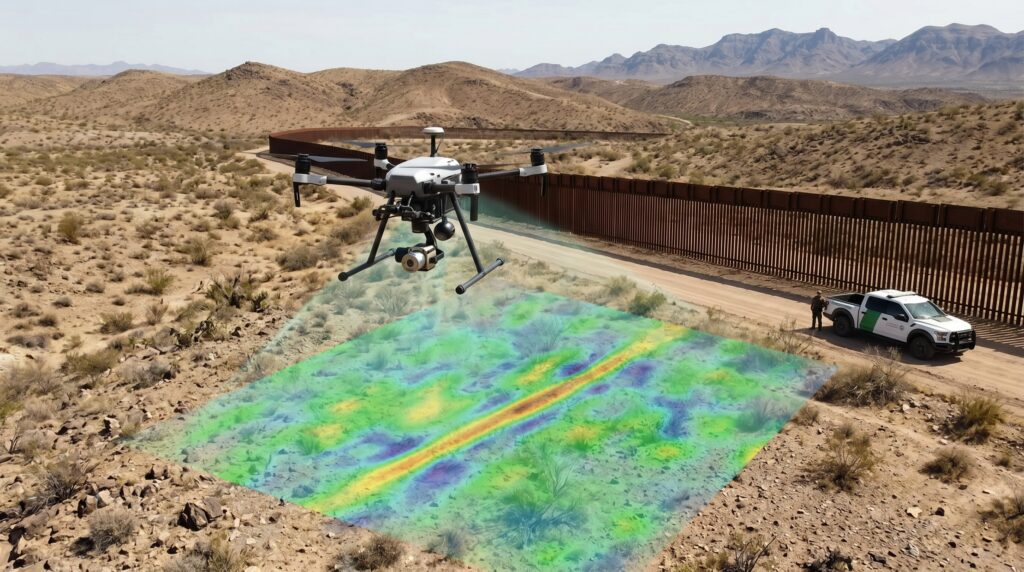
The magnetic advantage: Magnetic sensing offers two ways in. Where a structure is reinforced, the steel in reinforced concrete creates a contrast against the surrounding earth, so the construction gives itself away.
Even without reinforcement, cutting a void into the ground removes earth that would otherwise contribute to the local field, and a sensitive quantum magnetometer can likely register that absence. Because the sensor can be flown, a small drone can cover large or inaccessible areas far faster than a team on foot.
Who benefits: Defense and border security as well as civilian infrastructure: mapping buried utilities, locating voids beneath roads, and surveying construction sites.
#3: Unexploded ordnance survey
The challenge: Former conflict zones and training ranges remain dangerous for decades, and land can’t return to civilian use until it’s been cleared. Some of the clearest near-term value is humanitarian.
The gap: The conventional approach often puts people on the ground, walking a contaminated area directly over the hazard. Alternate approaches such as autonomous ground vehicles are slow to execute.
The magnetic advantage: Because unexploded ordnance is ferrous, it produces a magnetic anomaly, making MAD a natural fit. A sensor light and rugged enough to attach to a drone can move UXO surveys into the air, covering large distances quickly and keeping people away from dangerous ground.
Demining means searching every square meter of contaminated land, so cost per hectare determines whether clearance is viable. A small, lightweight sensor on a low-cost drone sweeps wide areas reliably and inexpensively; meanwhile, a heavy sensor on a large, expensive platform can’t scale. Field trials of drone-mounted magnetic surveys over buried ordnance point to the value of this kind of low-cost, repeatable coverage. Deployable technology makes the effort viable.
Who benefits: Humanitarian demining and post-conflict land clearance, as well as military range management and route clearance.
Real-world testing: In the Australian Army’s Quantum Technology Challenge 2023, teams detecting simulated anti-tank mines from a drone-mounted magnetometer survey correctly identified the number of mines in 93% of trials, pointing to fast, low-cost aerial coverage of large areas.
#4: Subsea and harbor approaches
The challenge: Small, quiet, uncrewed underwater vehicles can slip through harbor approaches and chokepoints. This is the use case closest to MAD’s submarine-hunting origin, now small and sensitive enough for use in everyday security.
The gap: Active sonar struggles in shallow, murky water. Because it broadcasts, it also tells any bad actors exactly where the sensor is located.
The magnetic advantage: Passive magnetic sensing detects a vehicle’s signature against the background field while emitting nothing; this is highly effective for an always-on, covert network guarding a harbor mouth or chokepoint. The tactic is not to chase a target across open water but to fence a line it must cross, spacing sensors so nothing passes through the gap undetected.
Who benefits: Commercial port and coastal infrastructure security, as well as naval harbor and approach protection.
#5: Obstructed object detection
The challenge: Hazards behind a wall, a vehicle, or a fold in the terrain (defilade) are invisible to conventional sensors until they emerge.
The gap: Cameras, radar, and LiDAR sensors need to see their target and cannot look through an obstruction.
The magnetic advantage: An object’s magnetic signature isn’t blocked by line of sight. Vector magnetic sensing registers a moving object before it becomes visible and resolves its heading and potentially even its size, and other characteristics such as a motor, adding warnings where optical and radar coverage has a gap.
Who benefits: Defense platforms, civilian safety systems, transport industry.
Magnetic sensors and their applications beyond defense and security
This list is hardly exhaustive. The full range of magnetic sensors and their applications extends well beyond defense and security, to non-invasive scanning of vehicles at checkpoints, mapping buried pipelines and cables, and survey and monitoring tasks across industry and infrastructure.
As sensors get smaller, more affordable, and easier to deploy en masse, questions start to shift away from capability and toward viability. If we can point magnetic sensors anywhere, which applications are most worthwhile?
Why NV-diamond quantum is the future for magnetic anomaly detection
Quantum magnetic sensors are emerging as the leading approach to MAD for two key reasons:
- Sensitivity has made new use cases viable. Quantum magnetic field detection reaches far smaller disturbances than conventional sensors, by an order of magnitude or more. That sensitivity has expanded the application space; it’s the difference between detecting only large, strongly magnetic objects and detecting the faint signature of an oncoming vehicle, a subsea UAV, or even a modified vehicle chassis.
- Information quality wins deployments. In the field, the challenge is less about sensitivity (detecting a faint signal) than clarity (separating the signal you want from everything else). A sensor that reports only a single number (e.g., field strength or a single vector), also known as a scalar sensor, can’t easily tell the two apart.
A vector sensor, which measures the field’s direction in three dimensions, can. It distinguishes a vehicle approaching from the left from one receding to the right, signatures that look far less clear to a scalar sensor. Combined with the pattern across several sensors, that directional information turns a raw detection into heading, position, and a first estimate of what the object is.
Across the field, deployment depends less on best-case sensitivity than on usable dynamic range, background rejection, and the quality of information a sensor delivers under real conditions. In magnetic anomaly detection, the winning sensor is the one that gives you the most actionable information.
Both properties come together in nitrogen-vacancy (NV) diamond magnetometers, a quantum sensing platform in which the four crystal orientations of the NV center provide an intrinsic vector measurement with no moving parts. The sensing is completely passive, with no emissions and no signal, making the benefits of NV-diamond sensing line up almost perfectly with the demands of MAD.
The deployability of NV-diamond quantum
Quantum sensing technology is not new, but quantum sensing you can carry, mount, integrate, and deploy at scale is just starting to reach the market. Several magnetic field detection sensor technologies reach the sensitivities MAD requires, but few have achieved viable use in the field, because most are hard to deploy.
Here’s why diamond is different:
| SQUID | Optically pumped (OPM) | NV-diamond | |
|---|---|---|---|
| Operating temperature | Cryogenic (needs cooling) | Near ambient, heated vapor cell | Room temperature |
| Typical platform | Helicopters, labs | Constrained field use | Drones, roadside, distributed nodes |
| Vector output | Yes | Single-axis | Intrinsic three-axis |
| Manufacturability | Impractical at high volume | Complex; requires specific technology | Semiconductor-style manufacturing, solid-state sensors |
- Ruggedness is built in. NV-diamond sensing happens inside a solid piece of diamond, one of the hardest, most stable materials on Earth. The same diamond that hosts the sensing protects it against shock, vibration, and temperature swings. Ruggedness is a property of the core.
- Room-temperature operation. Diamond NV sensors work at ambient temperature, with no cooling and no vacuum, removing the biggest barrier to deploying quantum sensing outside a controlled environment.
- Small, low-power footprint. With no cooling or bulky support hardware, diamond NV sensors are small, lightweight, and low power. They’re compact enough for a small drone, roadside installation, or distributed network, perfect for detecting minor anomalies.
- Designed for integration. A diamond quantum magnetometer integrates in much the same way as standard electronics: a compact sensor head and a circuit board, handled and designed much like any other PCB, with standard interfaces. Integrators design it in the way they would any other component, rather than building a platform around an exotic instrument.
- A path to volume production. Because diamond is chemically similar to the silicon the semiconductor industry already mass-produces, it has a credible route to high-volume manufacturing through standard semiconductor-style (OSAT) workflows.
Together, these properties make diamond quantum sensing inherently deployable, moving MAD out of controlled environments and onto small uncrewed aircraft, perimeter installations, distributed networks, and autonomous systems.
The bottom line on magnetic anomaly detection applications
Magnetic anomaly detection is about reading the disturbances every magnetic object leaves in the field around it. Quantum magnetic sensing lifts historical limitations, expanding detection across border security, subsurface and tunnel detection, unexploded ordnance survey, harbor protection, and an ever-widening set of civilian and defense applications.
Among quantum approaches, NV-diamond sensing is best-suited to leave the laboratory: sensitive, vector-capable, passive, rugged, room-temperature, integration-ready, and manufacturable at scale.
Quantum Brilliance is developing a room-temperature quantum magnetometer built for precisely this purpose. Constructed on diamond nitrogen-vacancy technology, it delivers room-temperature operation, high sensitivity, true three-axis vector output, and a compact, rugged design ready to integrate into the systems, platforms, and networks our partners build.
We are actively exploring a wide range of uses, including a recent cooperation with Honeywell Aerospace to develop compact quantum space magnetometer to advance research into Earth’s magnetic field.
Curious what quantum magnetic anomaly detection could do for your mission?
Contact us to learn more about quantum magnetometers for MAD applications.
About the author
Sarah Sharp is Vice President of Quantum Sensing and General Manager of Engineering and Product Delivery at Quantum Brilliance, where she leads the company’s quantum sensing business and its engineering and product delivery division. She specializes in translating emerging technologies into deployable operational capability.