
Diamond Quantum
Is diamond quantum technology practical?
The case for mass deployment of diamond.


Dr. marcus doherty
Marcus is internationally recognised as one of the pioneers of diamond quantum technologies. He is a scientist, educator, entrepreneur and soldier. As an entrepreneur, he uses his decades of experience in developing diamond quantum technology to shape the technology vision and development of Quantum Brilliance. As a scientist and educator, he is the past Head of the Diamond Quantum Science and Technology Laboratory and a current Honorary Fellow at the Australian National University, as well as an internationally-recognized expert in the physics of defects in semiconductors. As an educator, he is the architect of various graduate courses related to quantum science, technology and industry. As a soldier, he currently serves within the Future Land Warfare Branch of Army Headquarters, where he leads the implementation of Army’s Quantum Technology Roadmap.
Marcus holds a PhD from the University of Melbourne. His thesis, “The theory of the nitrogen-vacancy colour centre in diamond” was awarded the 2013 Chancellor’s Prize for Excellence. Throughout his career, Marcus has received numerous awards for his work including the Ruby Payne-Scott Medal of the Australian Institute of Physics, the C.N Yang Award of the Association of Asia Pacific Physical Societies, and the Conspicuous Service Medal of the Order of Australia for services to Australia in developing and executing Army’s Quantum Technology Strategy.
Key takeaways:
- Diamond quantum has a wider range of applications than any other platform. A single qubit type (the nitrogen-vacancy or NV center in diamond) covers nearly all of quantum sensing and quantum computing.
- Diamond works outside the lab. Diamond operates entirely at room temperature and pressure, with no cryogenics or vacuum chambers; it can be built compact, rugged, and energy-efficient to deploy effectively in the field.
- Diamond quantum is designed to be manufactured like a chip. Diamond is a true semiconductor technology; all parts of diamond quantum sensors and computers are compatible with the same manufacturing and packaging workflows that already produce classical electronics at massive scale, giving diamond the clearest path to volume in quantum.
- Diamond tech is proven by decades of research. NV centers have been studied for over 50 years by thousands of researchers worldwide, and 20+ years of peer-reviewed work on NV centers as qubits back our current application of this technology.
If you’ve learned to be skeptical of claims in quantum tech, you’re right to be. The field has a long habit of promising more than the hardware can deliver, and the news cycle is full of headlines that outrun the developments behind them.
Of course, claims about diamond quantum technology deserve the same scrutiny as every other claim in the quantum space. So in this article, I aim to address questions about the viability, deployability, and manufacturability of diamond quantum tech.
A short history of quantum diamond technology
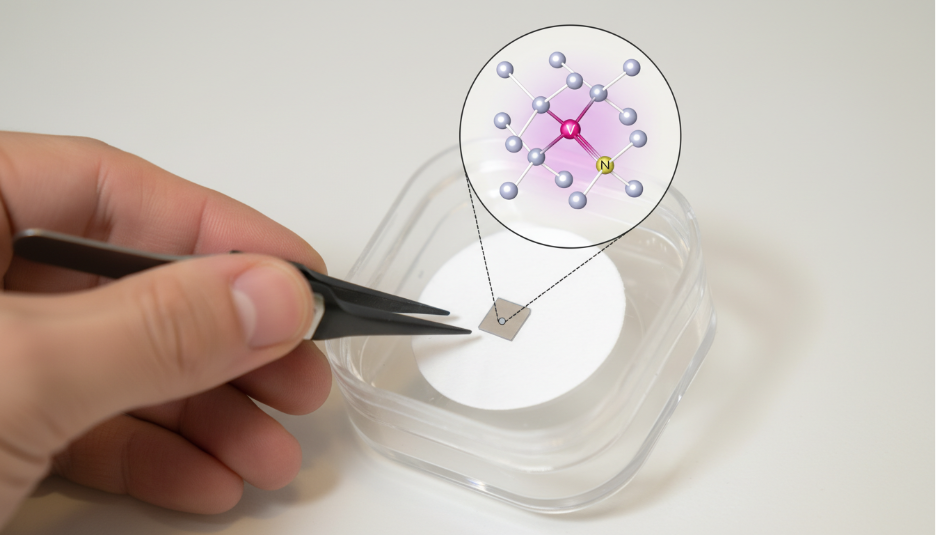
Diamond quantum tech is not new. The nitrogen-vacancy (NV) center, the atomic defect at the heart of our technology, has been studied since the late 1960s. Peer-reviewed research in the 2000s and 2010s established its core capabilities and applications as a qubit, including long room-temperature spin coherence and fast, high-fidelity operations.
A landmark 2009 study demonstrated room-temperature coherence times of more than one millisecond for NV centers in engineered diamond, exceeding those of many other qubit technologies, even ones that operate at cryogenic temperatures. Lattice vibrations are the primary cause of decoherence in many quantum systems, but diamond is so stiff that there isn’t enough thermal energy to create many vibrations, even at room temperature.
Can quantum technology really operate at room temperature?
The claim of “room-temperature operation” is sometimes used loosely across the industry, so I’ll take a moment to be precise about what I mean.
Some platforms described as room-temperature still depend on extreme cold or vacuum somewhere in the system. Certain photonic approaches, for instance, run their optics at room temperature but rely on superconducting photon detectors chilled to within a few degrees of absolute zero. Leading cold-atom and neutral-atom systems keep their control electronics at room temperature, but the qubits themselves are clouds of atoms laser-cooled to near absolute zero inside an ultra-high-vacuum chamber.
Diamond carries none of that hidden infrastructure. Every component, qubit included, operates at room temperature and pressure.
When you read about diamond quantum technology that runs entirely at room temperature and pressure, without the cryogenics, vacuums, and exotic infrastructure most people associate with other quantum technologies, it may sound too good to be true. But 20+ years of peer-reviewed work by thousands of researchers worldwide backs this technology.
Diamond quantum in sensing and computing
The maturity of quantum diamond shows up across both ends of the technology.
In sensing, NV-center devices built in university and national laboratories have measured magnetic fields, temperature, and pressure at a sensitivity and spatial resolution that rival or beat conventional instruments, and the underlying magnetometry has been validated in hundreds of peer-reviewed studies.
In computing, researchers have demonstrated the full set of building blocks a quantum computer needs: high-fidelity single- and two-qubit logic gates, and small multi-qubit registers that pair the NV center with nearby nuclear spins to store and process quantum information.
You might expect these results to stem from two different quantum technologies: one built for sensing, another for computing. But quantum diamond applies the same physics in both places, spanning nearly all of sensing and computing with a single qubit type:
- For a diamond quantum sensor, ensembles of many NV centers act together as the quantum detector.
- For a diamond quantum computer, arrays of NV centers process quantum information, with each individual NV center acting as a physical qubit.
The NV diamond qubit is the same building block in both cases; only its arrangement changes. In the same way the microelectronics industry builds different chips for a phone, radio, or computer from the same fundamental components, we build different quantum chips from the same diamond building blocks.
Why we chose quantum diamond: deployability
Quantum Brilliance sits at the present-day tip of over 50 years of research effort. We strongly believe that quantum is only useful if it’s deployable in large volumes. This is what we mean when we say, “take quantum anywhere.”
In this sense, deployability demands room-temperature operation. If your technology requires a dilution refrigerator or a vacuum chamber, it stays in the building with that infrastructure. Diamond removes that constraint.
Without cryogenics or vacuum plumbing, a diamond quantum sensor or processor can be small and energy-efficient. Its size, weight, power, and cost (SWaP-C) profile lets you design it into your platform rather than build a facility around it.
Of course, room-temperature operation alone doesn’t make diamond unique. Atomic vapor sensors run at room temperature, too. But no other platform combines room-temperature operation with a semiconductor-style manufacturing path. That combination is why diamond quantum can, in time, be manufactured at the same volumes as chips are today.
Can you manufacture diamond quantum technology at scale? The Smart Diamond chip
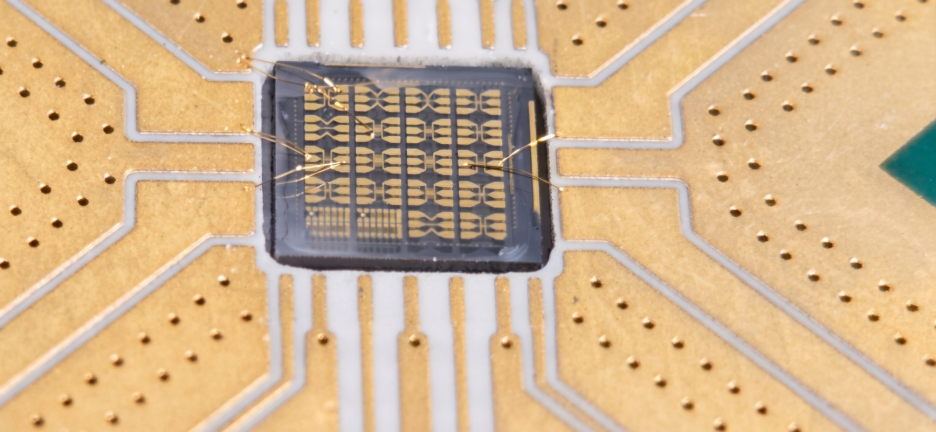
The key to manufacturing diamond quantum technology is the production of diamond chips with the correct layout of NV qubits, with the correct orientation, functionality and performance, and the electronic and photonics interfaces necessary to deliver the control signals to the qubits. We call these “Smart Diamond chips.”
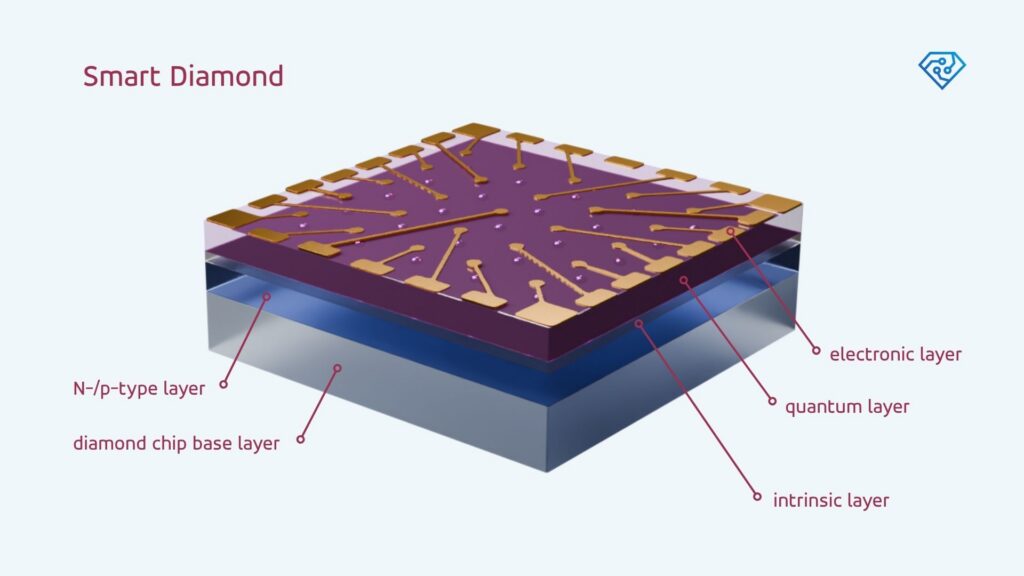
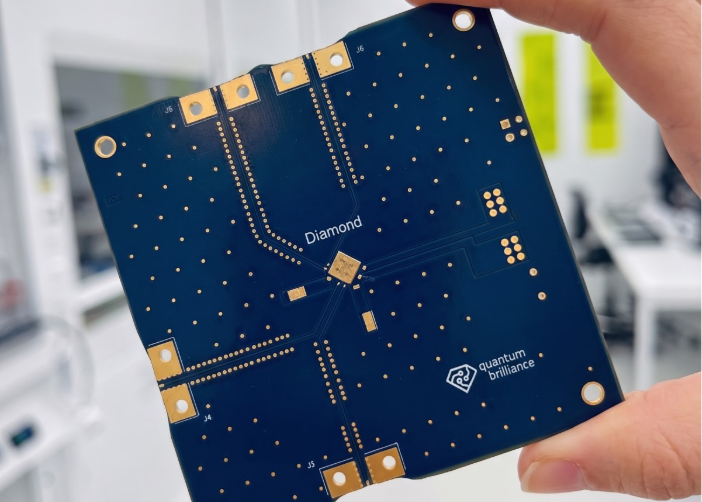
From there, the path to scale-up manufacturing is familiar. The Smart Diamond chip is assembled with off-the-shelf components that already exist in the semiconductor industry, packaged, and shipped. The only novel part of that flow is the diamond chip itself; everything else around it is already operating at full scale today.
Smart Diamond chips are designed to fit standard semiconductor packaging (OSAT) workflows, so they can be produced in the same way conventional chips are.
An important caveat: Large-scale diamond foundries don’t exist yet; we aren’t running diamond through a TSMC-scale line. Today, we work with smaller wafer sizes and smaller foundry lines.
We have established a quantum diamond foundry that works with diamond suppliers worldwide to improve material quality and scale up supply, building a sovereign, resilient supply of quantum-grade diamond substrates for computers and dense layers of ensembles of NV qubits for sensors.
Placing qubits atom by atom
That supply of qubits is furthest along for sensing; building qubits for computing is more challenging. The NV centers must be placed in aligned 2D arrays, spaced ~5 nanometers apart and precise to ~1 nanometer. That level of alignment and placement precision is essential; otherwise, it isn’t possible to drive the fast, high-fidelity two-qubit operations a fault-tolerant computer depends on.
Placing atoms to this degree of precision calls for fabrication techniques that didn’t exist before. Quantum Brilliance is building them by combining our own advanced diamond growth with semiconductor lithography adapted from the chip industry.
For both sensing and computing chips, we’re working with imec, the world’s leading independent semiconductor R&D hub, to move new chip technologies that require greater on-diamond integration of electronic and photonic interfaces, from the lab toward high-volume production.
How diamond compares to other quantum platforms
| Platform | Operating environment | Path to volume manufacturing | Applications |
|---|---|---|---|
| Diamond (NV) | Room temperature and pressure | Specialized diamond chip and conventional semiconductor fab | Sensing and computing |
| Superconducting | Millikelvin cryogenics | Cryostat production, specialized superconductor and conventional semiconductor fab | Sensing and computing |
| Neutral atoms / trapped ion | High vacuum with laser cooling or radio-wave traps | Vacuum component production, high-stability laser and optics production, conventional semiconductor fab | Computing |
| Atomic vapor | Room temperature | Precision-engineered glass cell production, integrated photonics | Sensing |
Compared to other quantum platforms, diamond’s position is distinctive.
Superconducting and trapped-ion/neutral atom systems have a head start on raw computing performance, but they are bound to the cryogenic refrigerators and vacuum chambers that keep them running, limiting how small they can get and how widely they can be deployed. Atomic-vapor sensors share diamond’s room-temperature advantage, but their precisely engineered glass cells are a significant barrier to manufacture at the volumes real-world deployment demands.
Diamond is the sole platform to pair room-temperature, room-pressure operation with a semiconductor manufacturing path. It also offers a single qubit that serves both sensing and computing.
If quantum technology is going to leave the laboratory and reach the vehicles, aircraft, drones, satellites, and data centers that need it, the technology must be both deployable and manufacturable at volume.
This is why we build the way we do. Our engineers are turning two decades of research into products the world can use.
Wondering whether diamond quantum technology is practical for your platform?
Talk to our team about your application and requirements.
About the author
Dr. Marcus Doherty CSM is a scientist, entrepreneur, educator, and soldier. As Chief Technology Officer of Quantum Brilliance, he leads the development of integrated quantum chips built on diamond. He’s an internationally recognized expert in the physics of semiconductor defects, a former Head of the Diamond Quantum Science and Technology Laboratory and current Honorary Fellow at the Australian National University, and the architect of graduate courses in quantum science and industry. He also serves as a Lieutenant Colonel in the Australian Army, leading the implementation of the Australian Army’s Quantum Technology Roadmap.